

.webp)
.webp)
.webp)



Learn how importers and workwear brands can source ripstop workwear based on fabric construction, durability, mobility, customization, and export capability.
Demanding industrial jobs require clothing that can withstand repeated movement, abrasion, changing weather, and daily wear. International buyers should therefore evaluate fabric construction, mobility, reinforcement, comfort, functionality, production consistency, and target-market requirements.
A reliable ripstop workwear manufacturer should provide garments suited to the intended industrial application. Ripstop construction can balance durability and weight, while reinforcement, ergonomic design, secure storage, and suitable materials can support everyday performance.
Ripstop fabrics use a reinforced woven structure designed to help limit the spread of small tears. This construction can be useful where garments regularly encounter equipment, rough surfaces, and repeated friction.
Ripstop construction does not by itself determine finished-garment durability. Fibre composition, fabric weight, seam quality, reinforcement, panels, closures, trims, and care conditions also influence performance.
Industrial workers may spend long periods climbing, kneeling, bending, carrying tools, or operating equipment. Workwear should provide suitable durability without unnecessarily restricting movement or adding excessive bulk.
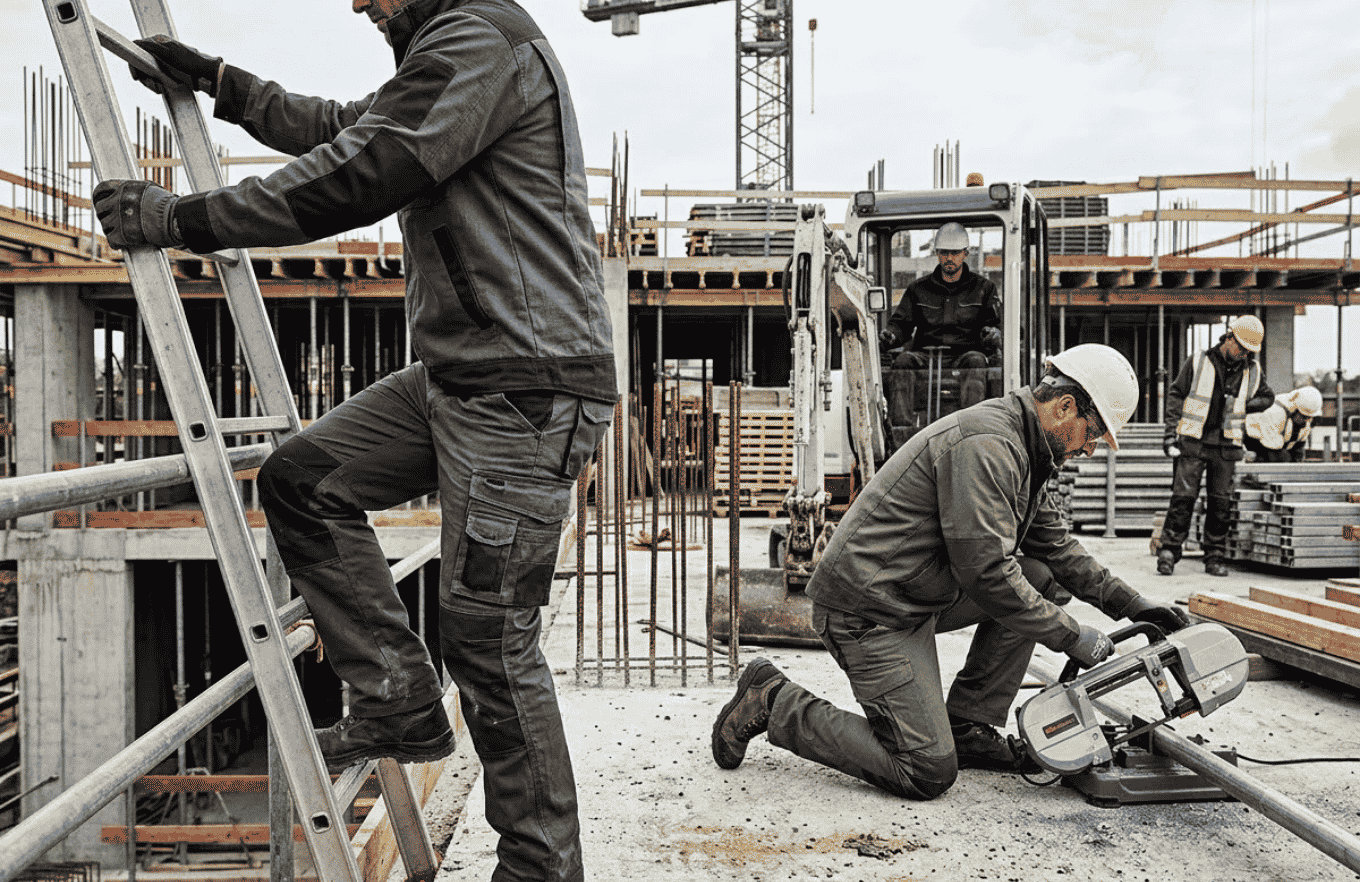
Before sourcing industrial workwear, buyers should define the tasks, hazards, climate, care conditions, and target market. Construction, maintenance, logistics, utilities, and industrial trades can require different garment specifications.
Buyers should review:
● Frequency of movement, bending and kneeling
● Exposure to abrasion and high-wear surfaces
● Indoor and outdoor working conditions
● Seasonal temperature changes
● Tool and equipment storage requirements
● Visibility requirements
● Compatibility with other PPE
● Expected washing and maintenance cycles
This approach helps prevent sourcing decisions based only on fabric weight, appearance, or initial price.
Industrial work often involves repeated stretching, walking, climbing, bending and kneeling. Garments that restrict these movements can affect comfort and practical task performance.
Features such as articulated knees, mechanical-stretch fabrics, ergonomic panels, and appropriately positioned seams can support mobility. Waist construction should also provide a secure and comfortable fit during prolonged wear.
The Torqueflex Utility Cargo Pant from Samad Workwear combines lightweight multi-panel construction, mechanical-stretch fabric, and an articulated knee design for active work environments. Reinforcement panels are positioned at high-wear areas, while double-stitched seams support durability.
Reflective print adds a visibility detail but should not be treated as a high-visibility compliance claim unless the complete garment has been assessed accordingly. Cargo pockets, zipped utility pockets, and tool-holder loops provide practical storage.
Workwear can form part of a worker's everyday tool-carrying system. Cargo compartments, secure zipped pockets and tool loops can provide convenient access to frequently used equipment.
However, storage should not interfere with movement or create unnecessary pressure when pockets are filled. Pocket placement, opening design, and garment balance should therefore be considered during product selection.
The Torqueflex Utility Cargo Pant combines multiple storage options with an ergonomic construction for workers who need regular access to tools during their shift.

Outdoor industrial workers can face cold temperatures, wind, and moisture during extended winter shifts. Workwear should provide suitable thermal comfort while allowing the movement required for the job.
Importers, distributors, and workwear brands should choose an industrial winter workwear manufacturer that develops garments for occupational conditions rather than general leisure use.
Insulation, body coverage, fit, adjustability, storage, fabric durability, and compatibility with other PPE should all be evaluated. Layering may also allow workers to adjust clothing according to temperature and activity levels.
We develop industrial garments for importers, workwear brands, distributors, and wholesalers around durability, mobility, storage, customization, seasonal conditions, and bulk export requirements.
Our Insulated Winter Bib Overall combines ripstop construction with thermal insulation for cold-weather industrial applications. Its full-bib design provides additional body coverage, while adjustable elastic suspenders and an elasticated back waist support fit adjustment.
The garment also includes a dual-entry front bib pocket, warm-lined side hand pockets, and additional storage features for outdoor industrial use.
Where EN ISO 13688 is specified, any compliance statement for the Torqueflex Utility Cargo Pant or Insulated Winter Bib Overall should be supported by documentation covering the exact finished garment and intended market.
EN ISO 13688 establishes general requirements for protective clothing, including ergonomics, innocuousness, size designation, ageing, compatibility, marking, and information supplied by the manufacturer.
It does not specify protection against a particular hazard and is intended for use with standards covering the required hazard-specific performance. Buyers should confirm the applicable edition and supporting documentation before making a compliance claim.
Selecting a custom industrial workwear supplier involves more than comparing product photographs and prices. Buyers should review material specifications, garment construction, sizing, customization, quality control, documentation, production capacity, and export capability.
For bulk orders, consistency across sizes, fabrics, stitching, and garment details is particularly important. Businesses should establish the approved product specification before moving into larger production quantities.
Samad Workwear supports product development, sampling, customization, private-label manufacturing, and bulk production, allowing international buyers to agree garment specifications before orders are finalized.
Ripstop workwear can be suitable for applications across:
● Construction
● Industrial maintenance
● Utilities
● Logistics and transportation
● Manufacturing
● Oil and gas support operations
● Agriculture
● Facilities management
● Outdoor service work
These environments can involve repeated movement, contact with equipment, changing weather, and prolonged garment use. Workwear should therefore be selected according to the actual working conditions.
For cold-weather operations, insulated garments can provide additional coverage and thermal comfort where required.
Choosing Samad Workwear allows importers, brands, distributors, and wholesalers to develop industrial garments according to durability, mobility, storage, weather conditions, branding, and intended use.
International buyers can review specifications, samples, customization, quality requirements, packaging, and bulk manufacturing details before production.
For businesses looking for a ripstop workwear manufacturer, fabric construction, reinforcement, sizing, garment features, care requirements, and intended application should be clearly established before production.
Buyers sourcing winter garments can also discuss insulation, body coverage, fit, storage, seasonal functionality, private labeling, and export packaging requirements.
Where protective clothing requirements apply, buyers should identify the relevant hazard-specific standard, conformity route, documentation, and target-market obligations before production.
Choosing ripstop workwear for demanding industrial jobs requires more than selecting a durable-looking fabric. Global buyers should evaluate fabric construction, reinforcement, mobility, storage, fit, weather protection, care requirements, production quality, and applicable standards.
Products such as the Torqueflex Utility Cargo Pant and Insulated Winter Bib Overall demonstrate different approaches to active industrial work and cold-weather requirements.
Clear technical specifications, approved samples, and agreed inspection criteria help international buyers achieve consistent quality across bulk and repeat orders.
Contact Samad Workwear to discuss ripstop garments, winter workwear, private-label development, samples, customization, and bulk export manufacturing.
Ripstop fabric can be suitable because its reinforced weave is designed to help limit tear propagation. Finished-garment performance also depends on fibre composition, fabric weight, stitching, reinforcement, care, and actual working conditions.
Buyers should evaluate climate, insulation, body coverage, mobility, fabric durability, fit, storage, weather exposure, care requirements, compatibility with other PPE, documentation, and manufacturing consistency.
No. EN ISO 13688 establishes general requirements for protective clothing. A particular workplace hazard normally requires another applicable standard and supporting assessment for the finished garment.